
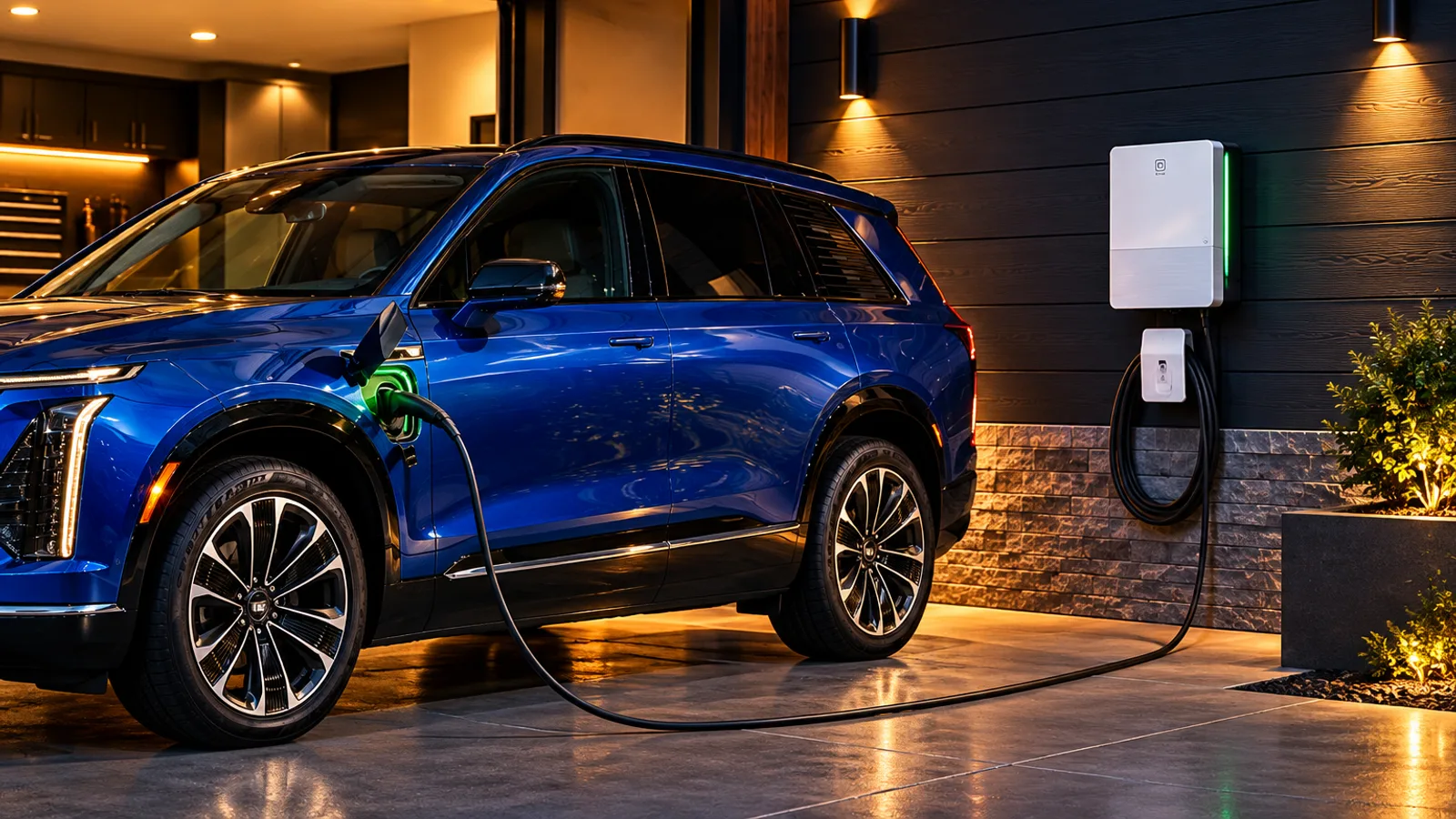
If you just bought an electric vehicle, or you have one on order, the charger at home matters more than any public station. Most EV owners in St. Louis and St. Charles County do nearly all of their charging in their own garage overnight. Here is what goes into a proper Level 2 installation, and how to tell whether your home is ready for one.
Level 1 vs. Level 2
Every EV comes with a cord that plugs into a standard 120V outlet. That is Level 1 charging, and it adds roughly 2 to 5 miles of range per hour. If you drive very little, that may be enough. For most commuters it is not.
A Level 2 charger runs on 240V and charges 5 to 10 times faster, around 25 to 30 miles of range per hour depending on the vehicle and charger. That means a full charge overnight.
One warning: do not run your EV off an extension cord. Extension cords are not rated for the sustained load of EV charging and can overheat.
The dedicated 240V circuit
A Level 2 charger needs its own dedicated 240V circuit, typically 50 amps, run from your panel to the charger location. It should not share a circuit with your garage outlets, freezer or tools. We size the breaker and wire for the charger you choose, run conduit to the location, and make every connection to NEC code.
Garage and outdoor installs are both common. For outdoor locations like a driveway or carport, we use weatherproof, NEMA-rated equipment.
EV Charger Installation for St. Charles & St. Louis County homes
Free on-site estimate, flat price before any work starts.
Hardwired or NEMA 14-50 outlet?
You have two basic options.
NEMA 14-50 outlet. We install a heavy-duty 240V outlet and you plug in a portable or plug-in charger. It gives you flexibility if you want to take the charger with you when you move. Depending on the code edition your municipality has adopted, this outlet may need GFCI protection.
Hardwired charger. The charger is wired directly to the circuit. Hardwiring generally allows higher charging speeds, removes the outlet as a wear point, and is the better fit for outdoor installs. Many wall chargers, including the Tesla Wall Connector, are designed to be hardwired.
We install all major brands, including Tesla, ChargePoint, Wallbox, Emporia, JuiceBox, Grizzl-E and Lectron, and we help you pick the right one for your vehicle and driving habits.
Load calculation: will your panel handle it?
Before we install anything, we look at your panel. A load calculation adds up what your home already draws (heating and cooling, water heater, range, dryer and so on) and tells us whether there is room for a 40 to 50 amp charging load.
Many homes with 200 amp service can add a charger with no upgrade. Homes with 100 amp service, or a full panel, often cannot. When capacity is tight, there are options:
- Load management. Some smart chargers and devices adjust charging speed based on what the house is using, which can avoid an upgrade in some homes.
- A panel upgrade. If your panel is undersized, outdated or one of the problem brands, upgrading to 200 amps solves the problem and prepares the house for future loads. You can read about that on our panel upgrade page.
We only recommend an upgrade when the numbers call for it.
Permits, inspection and setup
EV charger installations require a permit and inspection in both St. Louis and St. Charles counties. We pull the permit, schedule the inspection and stay on site for it. After it passes, we set up the charger, connect it to Wi-Fi, help you install the app, and confirm it charges your vehicle.
Plan ahead. Scheduling usually takes 1 to 2 weeks, so book before your car arrives if you can.
What it costs
- Standard installation: $950 to $1,400 (the panel has capacity and the charger is a short wire run from it)
- Extended installation: $1,400 to $2,100 (wire runs of roughly 20 to 50 feet, attic, basement or exterior routing)
- Complex installation: $2,100 to $3,500 (detached garage runs, trenching, older homes)
See what each tier includes on our EV charger installation page.
Your exact price depends on your home, and we quote it after the visit. We install chargers across the region, including Wentzville and Chesterfield, plus O'Fallon, St. Peters, Kirkwood, Ballwin and Wildwood.
FAQ
How long does installation take? Most installs take 2 to 4 hours. Long conduit runs or a panel upgrade add time.
Do I need a panel upgrade for an EV charger? Not always. Many 200 amp panels have room. We run a load calculation and only recommend an upgrade if your home needs it.
Can you install a charger outside? Yes. We install weatherproof chargers in driveways, carports and detached garages.
Get your home ready to charge
Learn more on our EV charger installation page, or book a free site survey and we will tell you exactly what your home needs and what it will cost before any work begins.